



Foreword
I am a novice in BGP. This article may contain imprecise content/naive understandings/elementary mistakes. I kindly ask the experts to be lenient. If you find any issues, you are welcome to contact me via email, and I will correct them as soon as possible. If you find this unacceptable, it is recommended to close this article now.
Welcome to peer with me! For details, please visit: iYoRoy DN42 Network
I wanted to study BGP, but renting an ASN and IP block is too expensive, and I was afraid of taking down half the internet due to a configuration error. So, I decided to look into DN42, a virtual network. DN42 is a large decentralized network that uses the BGP protocol for routing, making its structure very similar to today's internet. This makes it suitable for learning networking technologies like BGP. In DN42, everyone plays the role of an ISP (Internet Service Provider), peering with other users to join and participate in building the entire DN42 network. DN42 operates on 172.20.0.0/14 and fd00::/8, both of which are private address ranges, so it won't affect the clearnet.
Registration
You need to know basic git commands, GPG, and Linux. It's also best to sign your commits with GPG. If you have basic Git knowledge, you can refer to my commit: Add AS4242422024 · d1f9046ecb - registry - dn42 git
Fork and Clone the DN42 Registry Git Repository
Register an account on dn42 git and Fork the dn42/registry repository. Clone your forked repository and enter it.
Register a Contact
Create a file named <Nickname>-DN42 under data/person and fill in the following content:
person:             <Nickname>
e-mail:             <Email Address>
pgp-fingerprint:    <GPG Key Fingerprint>
nic-hdl:            <NIC Handle>
mnt-by:             <Maintainer>
source:             DN42
person: Nickname.e-mail: Email address.pgp-fingerprint: GPG key fingerprint, used for some authentication services.nic-hdl: NIC handle, points to the file itself, just use the current filename.mnt-by: Maintained by, points to the maintainer information from the Register Maintainer section below.source: Source, keep it asDN42.www: Optional, your website URL.
person:             Kagura iYoRoy
e-mail:             [email protected]
www:                https://www.iyoroy.cn
pgp-fingerprint:    3ECCFFDEC2CB4CB8DA8089BE9AF2F2E03CE8FD67
nic-hdl:            IYOROY-DN42
mnt-by:             IYOROY-MNT
source:             DN42
{/collapse-item}
Register a Maintainer
Create a file data/mntner/<Nickname>-MNT and fill in the following content:
mntner:             <Nickname>-MNT
admin-c:            <Contact>
tech-c:             <Contact>
auth:               <Authentication Method>
mnt-by:             <Maintainer>
source:             DN42
mntner: Maintainer name, generally the same as the filename.admin-c: Administrator contact information, points to a file in thepersonfolder, use the filename from the Register Contact section above.tech-c: Technical contact information, points to a file in thepersonfolder, use the filename from the Register Contact section above.auth: Authentication method, supports pgp or ssh-key.mnt-by: Maintained by, generally points to the filename itself.source: Source, keep it asDN42.
mntner:             IYOROY-MNT
admin-c:            IYOROY-DN42
tech-c:             IYOROY-DN42
auth:               pgp-fingerprint 3ECCFFDEC2CB4CB8DA8089BE9AF2F2E03CE8FD67
mnt-by:             IYOROY-MNT
source:             DN42
{/collapse-item}
Register an ASN
On the clearnet, 4200000000 - 4294967294 is the reserved range for ASNs. DN42 uses 4242420000 - 4242429999, and currently, 4242420000 - 4242423999 is open for registration.The official recommendation is not to manually find an available ASN but to use Burble's DN42 Free ASN Explorer to select an available ASN for registration.
After choosing your desired ASN, create a file <ASN, including AS letters> in data/aut-num and fill in the following content:
aut-num:            <ASN>
as-name:            <Autonomous System Name>
descr:              <Autonomous System Description>
admin-c:            <Administrator NIC Handle>
tech-c:             <Technical Contact NIC Handle>
mnt-by:             <Maintainer>
source:             DN42
aut-num: Your chosen ASN, including the AS prefix. It should be in the format AS424242xxxx.as-name: Autonomous System Name.descr: Autonomous System Description, can contain spaces.admin-c: Administrator contact information, points to a file in thepersonfolder, use the filename from the Register Contact section above.tech-c: Technical contact information, points to a file in thepersonfolder, use the filename from the Register Contact section above.mnt-by: Maintained by, points to the filename from the Create Maintainer section above.source: Source, keep it asDN42.
aut-num:            AS4242422024
as-name:            IYOROYNET-AS-DN42
descr:              iYoRoy DN42 Network
admin-c:            IYOROY-DN42
tech-c:             IYOROY-DN42
mnt-by:             IYOROY-MNT
source:             DN42
{/collapse-item}
Register an IPv4 Block and Add Route
You can skip this section if you don't want to register IPv4 The official provides a tool for finding available address blocks: DN42 Free IPv4 Explorer. It is also not recommended to manually specify but to use the available blocks found through the search tool. DN42 also faces IPv4 address shortages, so please register according to your needs. Generally, a /27 block containing 30 usable IPv4 addresses is sufficient. For smaller networks, you can apply for /28 (14 usable addresses) and /29 (6 usable addresses). The largest block that can be directly applied for is /26, which is 62 addresses. Applying for /25, /24 requires submitting an application and waiting for review. For details, refer to: DN42 Experimental Network: Intro and Registration (Updated 2022-12) - Lan Tian @ Blog
After selecting your IPv4 block, create a file in data/inetnum named after the CIDR format of the IPv4 block, using _ instead of / (e.g., if the applied IPv4 block is 172.20.234.224/28, the filename is 172.20.234.224_28), and fill in the content:
inetnum:            <First IPv4 Address in Block> - <Last IPv4 Address in Block>
cidr:               <IPv4 Block in CIDR Format>
netname:            <IPv4 Block Name>
descr:              <IPv4 Block Description>
country:            <Country Code for IPv4 Block>
admin-c:            <Administrator NIC Handle>
tech-c:             <Technical Contact NIC Handle>
mnt-by:             <Maintainer>
status:             ASSIGNED
source:             DN42
inetnum: IPv4 address range, from the first address to the last address, connected with-.cidr: IPv4 block in CIDR format, do not replace/with_.netname: IPv4 block name, fill in as desired, no special requirements.descr: IPv4 block description, can contain spaces.country: Two-character country code from ISO 3166, for China, fill inCN.admin-c: Administrator contact information, points to a file in thepersonfolder, use the filename from the Register Contact section above.tech-c: Technical contact information, points to a file in thepersonfolder, use the filename from the Register Contact section above.mnt-by: Maintained by, points to the filename from the Create Maintainer section above.status: Status, keep it asASSIGNED.source: Source, keep it asDN42.
inetnum:            172.20.234.224 - 172.20.234.239
cidr:               172.20.234.224/28
netname:            IYOROYNET-DN42-V4
descr:              iYoRoy DN42 Network IPv4 Block
country:            CN
admin-c:            IYOROY-DN42
tech-c:             IYOROY-DN42
mnt-by:             IYOROY-MNT
status:             ASSIGNED
source:             DN42
{/collapse-item}
Next, under data/route, create a file also named after the IPv4 block's CIDR format, using _ instead of /, and fill in the content:
route:              <IPv4 Block in CIDR Format>
origin:             <ASN>
max-length:         <IPv4 Prefix Length>
mnt-by:             <Maintainer>
source:             DN42
route: IPv4 block, fill in CIDR format, do not convert/.origin: ASN, needs to includeASprefix.max-lenth: Prefix Length, i.e., the number after/in the CIDR format.mnt-by: Maintained by, points to the filename from the Create Maintainer section above.source: Source, keep it asDN42.
route:              172.20.234.224/28
origin:             AS4242422024
max-length:         28
mnt-by:             IYOROY-MNT
source:             DN42
{/collapse-item}
Register an IPv6 Block and Add Route
You can skip this section if you don't want to register IPv6
Similarly, use the official tool to find available IPv6: DN42 Free IPv6 Explorer 。
After selecting the address block, create a file under data/inet6num named after the IPv6 block's CIDR format, using _ instead of / (e.g., if the IPv6 block is fd18:3e15:61d0::/48, the filename is fd18:3e15:61d0::_48), and fill in the content:
inet6num:           <First IPv6 Address in Block> - <Last IPv6 Address in Block>
cidr:               <IPv6 Block in CIDR Format>
netname:            <IPv6 Block Name>
descr:              <IPv6 Block Description>
country:            <Country Code for IPv6 Block>
admin-c:            <Administrator NIC Handle>
tech-c:             <Technical Contact NIC Handle>
mnt-by:             <Maintainer>
status:             ASSIGNED
source:             DN42
inet6num: IPv6 address range, from the first address to the last address, cannot use::shorthand, connected with -. For example, if my block isfd18:3e15:61d0::/48, I need to fill infd18:3e15:61d0:0000:0000:0000:0000:0000-fd18:3e15:61d0:ffff:ffff:ffff:ffff:ffff.cidr: IPv6 block in CIDR format, do not replace/with_.netname: IPv6 block name, fill in as desired, no special requirementsdescr: IPv6 block description, can contain spacescountry: Two-character country code from ISO 3166, for China, fill inCN.admin-c: Administrator contact information, points to a file in thepersonfolder, use the filename from the Register Contact section above.tech-c: Technical contact information, points to a file in thepersonfolder, use the filename from the Register Contact section above.mnt-by: Maintained by, points to the filename from the Create Maintainer section above.status: Status, keep it asASSIGNED.source: Source, keep it asDN42.
inet6num:           fd18:3e15:61d0:0000:0000:0000:0000:0000 - fd18:3e15:61d0:ffff:ffff:ffff:ffff:ffff
cidr:               fd18:3e15:61d0::/48
netname:            IYOROYNET-DN42-V6
descr:              iYoRoy DN42 Network IPv6 Block
country:            CN
admin-c:            IYOROY-DN42
tech-c:             IYOROY-DN42
mnt-by:             IYOROY-MNT
status:             ASSIGNED
source:             DN42
{/collapse-item}
Next, under data/route6, create a file also named after the IPv6 block's CIDR format, using _ instead of /, and fill in the content:
route6:             <IPv6 Block in CIDR Format>
origin:             <ASN>
max-length:         <IPv6 Prefix Length>
mnt-by:             <Maintainer>
source:             DN42
route6: IPv6 block, fill in CIDR format, do not convert/.origin: ASN, needs to includeASprefix.max-lenth: Prefix Length, i.e., the number after/in the CIDR format.mnt-by: Maintained by, points to the filename from the Create Maintainer section above.source: Source, keep it asDN42.
route6:             fd18:3e15:61d0::/48
origin:             AS4242422024
max-length:         48
mnt-by:             IYOROY-MNT
source:             DN42
{/collapse-item}
Create and Push Commit, Submit PR
It's best to sign your commits with GPG and upload your public key to dn42 git.
After filling in the above information, return to the root directory of the repository and run the script ./fmt-my-stuff <Maintainer> to automatically format the configuration files. Note: Here <Maintainer> is the value of mntner from the Register Maintainer chapter. Then follow the normal git commit process: git add data/, git commit -S -m "<commit-msg>" to create the commit, git push origin master to push. Then, go to the dn42 git web interface, open your forked repository, and submit a Pull Request.
If there are configuration issues, the automated review bot and administrators will inform you. Please patiently modify according to the requirements and merge into the original commit, do not create a new commit. It is recommended to use git commit --amend after git add. After modification, force push directly (git push origin master --force).
The working language of the DN42 Registry is English. Please use English for the entire process to avoid unnecessary trouble.
Configuring Bird
First, install bird. Using Ubuntu 22.04 as an example:
apt install bird2 -y
If you also want to install WireGuard for later use, add the wireguard and wireguard-tools packages:
apt install bird2 wireguard wireguard-tools -y
Create Configuration Files
bird.conf
Modify /etc/bird/bird.conf:
define OWNAS       = <AS Number>;
define OWNIP       = <DN42 IPv4 Address>;
define OWNIPv6     = <DN42 IPv6 Address>;
define OWNNET      = <DN42 IPv4 Block, CIDR Format>;
define OWNNETv6    = <DN42 IPv6 Block, CIDR Format>;
define OWNNETSET   = [ <DN42 IPv4 Block, CIDR Format>+ ];
define OWNNETSETv6 = [ <DN42 IPv6 Block, CIDR Format>+ ];

router id OWNIP;

protocol device {
    scan time 10;
}

function is_self_net() {
    return net ~ OWNNETSET;
}

function is_self_net_v6() {
    return net ~ OWNNETSETv6;
}

function is_valid_network() {
    return net ~ [
        172.20.0.0/14{21,29}, # dn42
        172.20.0.0/24{28,32}, # dn42 Anycast
        172.21.0.0/24{28,32}, # dn42 Anycast
        172.22.0.0/24{28,32}, # dn42 Anycast
        172.23.0.0/24{28,32}, # dn42 Anycast
        172.31.0.0/16+,       # ChaosVPN
        10.100.0.0/14+,       # ChaosVPN
        10.127.0.0/16{16,32}, # neonetwork
        10.0.0.0/8{15,24}     # Freifunk.net
    ];
}

function is_valid_network_v6() {
  return net ~ [
    fd00::/8{44,64} # ULA address space as per RFC 4193
  ];
}

protocol kernel {
    scan time 20;

    ipv6 {
        import none;
        export filter {
            if source = RTS_STATIC then reject;
            krt_prefsrc = OWNIPv6;
            accept;
        };
    };
};

protocol kernel {
    scan time 20;

    ipv4 {
        import none;
        export filter {
            if source = RTS_STATIC then reject;
            krt_prefsrc = OWNIP;
            accept;
        };
    };
}

protocol static {
    route OWNNET reject;

    ipv4 {
        import all;
        export none;
    };
}

protocol static {
    route OWNNETv6 reject;

    ipv6 {
        import all;
        export none;
    };
}

include "rpki.conf";
include "ebgp.conf";
Here, the OWNIP and OWNIPV6 parameters refer to the DN42 IPv4 and IPv6 addresses assigned to this machine, not the address of the block. For example, if I obtained the address segment 172.20.234.224/28 and assigned 172.20.234.225 to machine A, then OWNIP is 172.20.234.225. The same applies to IPv6.
rpki.conf
You might have seen other tutorials using cron jobs + reloading Bird to update ROAs. Configuring RPKI here is another way to configure ROAs.
Create /etc/bird/rpki.conf and fill in the following content:
roa4 table dn42_roa;
roa6 table dn42_roa_v6;

protocol rpki dn42_rpki_akix {
    roa4 { table dn42_roa; };
    roa6 { table dn42_roa_v6; };
    remote "<rpki server address>" port 8082; # change it
    refresh 30;
    retry 5;
    expire 600;
}
For the RPKI server, you can use the service provided by my friend's AkaereIX: rpki.akae.re.
roa4 table dn42_roa;
roa6 table dn42_roa_v6;

protocol rpki dn42_rpki_akix {
    roa4 { table dn42_roa; };
    roa6 { table dn42_roa_v6; };
    remote "rpki.akae.re" port 8082;
    refresh 30;
    retry 5;
    expire 600;
}
{/collapse-item}
ebgp.conf
Create /etc/bird/ebgp.conf and fill in the following content:
template bgp dnpeers {
    local as OWNAS;
    path metric 1;

    ipv4 {
        import filter {
            if is_valid_network() && !is_self_net() then {
                if (roa_check(dn42_roa, net, bgp_path.last) != ROA_VALID) then {
                    print "[dn42] ROA check failed for ", net, " ASN ", bgp_path.last;
                    reject;
                }
                accept;
            }
            reject;
        };

        export filter {
            if is_valid_network() && source ~ [RTS_STATIC, RTS_BGP] then accept;
            reject;
        };
        import limit 1000 action block;
    };

    ipv6 {
        import filter {
            if is_valid_network_v6() && !is_self_net_v6() then {
                if (roa_check(dn42_roa_v6, net, bgp_path.last) != ROA_VALID) then {
                    print "[dn42] ROA check failed for ", net, " ASN ", bgp_path.last;
                    reject;
                }
                accept;
            }
            reject;
        };
        export filter {
            if is_valid_network_v6() && source ~ [RTS_STATIC, RTS_BGP] then accept;
            reject;
        };
        import limit 1000 action block;
    };
}


include "peers/*";
This configuration defines a template for peering within DN42 and references all configuration files under /etc/bird/peers. Later, when we peer, we only need to create configuration files here according to the template and write them.
Create the /etc/bird/peers folder for subsequent peering.
System Configuration
Kernel
Because each node may act as a router for other nodes, Linux kernel packet forwarding needs to be enabled. Also, because WireGuard is used, which doesn't forward through physical network cards, the rp_filter strict mode needs to be disabled.
echo "net.ipv4.ip_forward=1" >> /etc/sysctl.conf
echo "net.ipv6.conf.default.forwarding=1" >> /etc/sysctl.conf
echo "net.ipv6.conf.all.forwarding=1" >> /etc/sysctl.conf
echo "net.ipv4.conf.default.rp_filter=0" >> /etc/sysctl.conf
echo "net.ipv4.conf.all.rp_filter=0" >> /etc/sysctl.conf
sysctl -p
DN42 Virtual Network Interface
Because MP-BGP typically uses LLA addresses to establish BGP sessions, we need to set up a dummy network interface in the system and bind the DN42 IP we assigned to this machine. Run the following commands:
ip link add dn42 type dummy
ip addr add <DN42 IPv4 assigned to this machine> dev dn42
ip addr add <DN42 IPv6 assigned to this machine> dev dn42
If persistent configuration is needed, you can refer to the following three methods:
tee /etc/systemd/network/10-dn42.netdev > /dev/null <<EOF
[NetDev]
Name=dn42
Kind=dummy
EOF

tee /etc/systemd/network/20-dn42.network > /dev/null <<EOF
[Match]
Name=dn42

[Network]
Address=<DN42 IPv4 assigned to this machine>/32
Address=<DN42 IPv6 assigned to this machine>/128
EOF

systemctl enable systemd-networkd
systemctl restart systemd-networkd
{/tabs-pane} {tabs-pane label="netplan"}
tee /etc/netplan/99-dn42.yaml > /dev/null <<EOF
network:
  version: 2
  renderer: networkd
  ethernets:
    dn42:
      match:
        name: dn42
      addresses:
        - <DN42 IPv4 assigned to this machine>/32
        - "<DN42 IPv6 assigned to this machine>/128"
      accept-ra: no
EOF

netplan apply
{/tabs-pane} {tabs-pane label="/etc/network/interfaces"}
tee -a /etc/network/interfaces > /dev/null <<EOF
auto dn42
iface dn42 inet static
    address <DN42 IPv4 assigned to this machine>
    netmask 255.255.255.255

iface dn42 inet6 static
    address <DN42 IPv6 assigned to this machine>/128
EOF

ifup dn42
{/tabs-pane}
Peering with Other Members
A user-friendly option for beginners is Potat0's self-service peering service. For details, refer to his DN42 Network page. Follow the instructions to find his Automatic Peering Bot, register your account with the bot by providing your DN42 ASN, the email recorded in the Maintainer during registration above (this is why it's best to fill in the email during registration, as many verification services use it), and receive the verification code with that email. Then, follow the bot's requirements to establish the peer.
Install WireGuard
apt install wireguard wireguard-tools -y
Note: Modern package managers usually automatically install wireguard-tools when installing wireguard to use the wg-quick command.
Generate Key Pair
wg genkey | tee privatekey | wg pubkey > publickey
Note down the contents of privatekey and publickey, representing the private and public keys respectively.
Establishing a Peer
Generally, there are two modes for establishing a peer: using MP-BGP (Multiprotocol BGP) and not using MP-BGP. Personally, I find MP-BGP more common because its configuration is relatively simple. The configurations are slightly different, so please refer according to your needs.
Using MP-BGP
Exchanging Information with the Peer
You need to provide the other party with the following information, and you also need to know the other party's corresponding information:
- Public Key
- Public IP Address (non-DN42 address)
- Public WireGuard Port, usually listening on the last 5 digits of the other party's ASN
- DN42 ASN
- LLA (Link-Local Address), generally
fe80::<last 4 digits of peer's ASN> - Whether ENH (Extended Next Hop) is supported. Note: If using v6 to exchange routes without enabling ENH, v4 routes cannot be exchanged.
Sometimes the public IP address and public WG port are combined and called the Endpoint.
Configuring WireGuard
Create a configuration file under /etc/wireguard. The name is arbitrary, but my naming convention is dn42-<last 4 digits of peer's ASN>.conf, where dn42-xxxx is the tunnel name. Fill the file with the following content:
[Interface]
PrivateKey = <Private key generated in the "Generate Key Pair" section above>
ListenPort = <Public WireGuard Listen Port>
Table = off
Address = <Your LLA Address>/64
PostUp = sysctl -w net.ipv6.conf.%i.autoconf=0

[Peer]
PublicKey = <Peer's Public Key>
Endpoint = <Peer's Endpoint, i.e., IP:Port>
AllowedIPs = 10.0.0.0/8, 172.20.0.0/14, 172.31.0.0/16, fd00::/8, fe00::/8
After editing and saving, run:
wg-quick up <Tunnel Name>
This will start the WG tunnel. Use wg show <Tunnel Name> to check the connection status. Running wg directly shows the status of all tunnels.
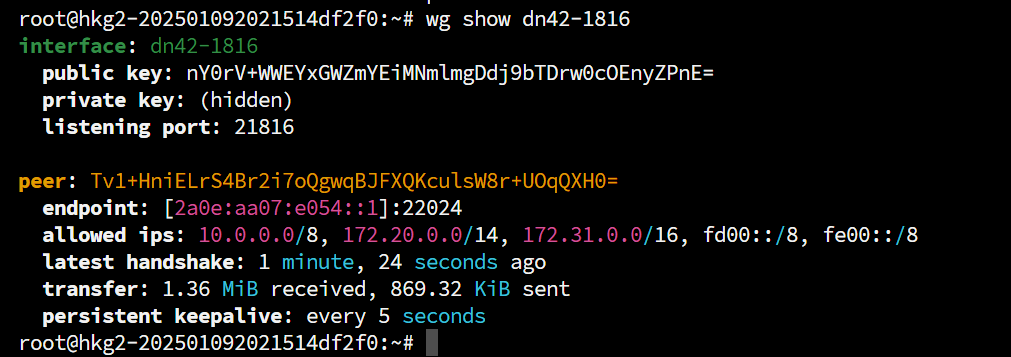
If you want the tunnel to start automatically on boot, run:
systemctl enable wg-quick@<Tunnel Name>
Configuring the Bird2 Peer Section
Create a new file <Name>.conf under /etc/bird/peers and fill in the following content:
protocol bgp <BGP Session Name> from dnpeers{
    neighbor <Peer's LLA Address> % '<WireGuard Tunnel Name>' as <Peer's ASN, without AS prefix>;
};
If Extended Next Hop is used (as negotiated during information exchange above), configure:
protocol bgp <BGP Session Name> from dnpeers{
    neighbor <Peer's LLA Address> % '<WireGuard Tunnel Name>' as <Peer's ASN, without AS prefix>;
    ipv4{
        extended next hop;
    };
};
Applying Configuration
Run birdc configure (or birdc c, equivalent) to reload the Bird configuration, then run birdc show protocols (or birdc s p, equivalent) to view the currently established BGP connections.
root@hkg2-202501092021514df2f0:~# birdc show protocols
BIRD 2.0.12 ready.
Name       Proto      Table      State  Since         Info
device1    Device     ---        up     07:24:14.255
static1    Static     dn42_roa   up     07:24:14.255
static2    Static     dn42_roa_v6 up     07:24:14.255
kernel1    Kernel     master6    up     07:24:14.255
kernel2    Kernel     master4    up     07:24:14.255
static3    Static     master4    up     07:24:14.255
static4    Static     master6    up     07:24:14.255
dn42-0298  BGP        ---        up     08:03:13.347  Established
dn42-1816  BGP        ---        up     07:53:05.028  Established
Not Using MP-BGP
Exchanging Information with the Peer
You need to provide the other party with the following information, and you also need to know the other party's corresponding information:
- Public Key
- Public IP Address (non-DN42 address)
- Public WireGuard Port, usually listening on the last 5 digits of the other party's ASN
- DN42 ASN
- DN42 IP, if exchanging IPv4 routes, an IPv4 address is needed; if exchanging IPv6 routes, an IPv6 address is needed.
Sometimes the public IP address and public WG port are combined and called the Endpoint.
Configuring WireGuard
Create a configuration file under /etc/wireguard. The name is arbitrary, but my naming convention is dn42-<last 4 digits of peer's ASN>.conf, where dn42-xxxx is the tunnel name. Fill the file with the following content:
[Interface]
PrivateKey = <Private key generated in the "Generate Key Pair" section above>
ListenPort = <Public WireGuard Listen Port>
Table = off
PostUp = ip addr add <LLA>/64 dev %i
PostUp = ip addr add <Local DN42 IPv6> dev %i
PostUp = ip addr add <Local DN42 IPv4> peer <Peer's DN42 IPv4> dev %i
PostUp = sysctl -w net.ipv6.conf.%i.autoconf=0

[Peer]
PublicKey = <Peer's Public Key>
Endpoint = <Peer's Endpoint, i.e., IP:Port>
AllowedIPs = 10.0.0.0/8, 172.20.0.0/14, 172.31.0.0/16, fd00::/8, fe00::/8
After editing and saving, run:
wg-quick up <Tunnel Name>
This will start the WG tunnel. Use wg show <Tunnel Name> to check the connection status. Running wg directly shows the status of all tunnels.
If you want the tunnel to start automatically on boot, run:
systemctl enable wg-quick@<Tunnel Name>
Configuring the Bird2 Peer Section
Create a new file <Name>.conf under /etc/bird/peers and fill in the following content:
protocol bgp <v4 BGP Session Name> from dnpeers{
    neighbor <Peer's DN42 IPv4 Address> as <Peer's ASN, without AS prefix>;
    direct;
    ipv6{
        import none;
        export none;
    };
};

protocol bgp <v6 BGP Session Name> from dnpeers{
    neighbor <Peer's DN42 IPv6 Address> % '<WireGuard Tunnel Name>' as <Peer's ASN, without AS prefix>;
    direct;
    ipv4{
        import none;
        export none;
    };
};
Applying Configuration
Run birdc configure (or birdc c, equivalent) to reload the Bird configuration, then run birdc show protocols (or birdc s p, equivalent) to view the currently established BGP connections.
At this point, we have successfully joined the DN42 network. To make the network more stable, we can peer with more users, establishing multiple BGP lines to prevent disconnection if some nodes fail. You can join the DN42 Unofficial Telegram Group for more information.
If BGP is Established but you cannot Ping internal DN42 IPs, check if the IP set in bird.conf matches the IP assigned to the dummy interface or the local IP in WireGuard.
Configuring DNS
DN42 has its own public DNS with the anycast address 172.20.0.53, which can also resolve normal internet domains. To access internal domains ending with .dn42, you need to put this address at the top of resolv.conf:
nameserver 172.20.0.53
nameserver 223.5.5.5 # Below are normal DNS server configurations
After this, you can resolve DN42 internal domain names. Also, commands like ping, traceroute, and mtr will show rDNS resolution results when querying internal IPs.
Welcome to peer with me! For details, please visit: iYoRoy DN42 Network
References:
- https://blog.baoshuo.ren/post/dn42-network/
- https://dn42.dev/howto/Bird2#example-configuration
- https://dn42.eu/howto/wireguard
- https://blog.udon.eu.org/archives/dbf21067.html
- https://blog.byteloid.one/2025/06/02/babeld-over-wireguard/
- https://blog.wcysite.com/2021/%E8%B8%A9%E5%9D%91DN42-p2-peer/
- https://blog.chs.pub/p/23-14-joindn42/
- https://www.cnblogs.com/FengZeng666/p/15583434.html
![[Fun Experiment] A LAN Spanning 20km: Seamlessly Merging Remote Networks on OpenWrt Using ZeroTier + OSPF](https://www.iyoroy.cn/usr/uploads/2026/02/2688666886.png)



佬,cn节点peer吗
可以的
[...]source: DN42admin-c、tech-c、mnt-by请参考DN42探究日记 - Ep.1 加入DN42网络{collapse-item label="样例"}data/dns/yori.dn42domain: yori.dn42[...]